AFRICA’S DATA GAP IS BECOMING AN INVESTMENT GAP
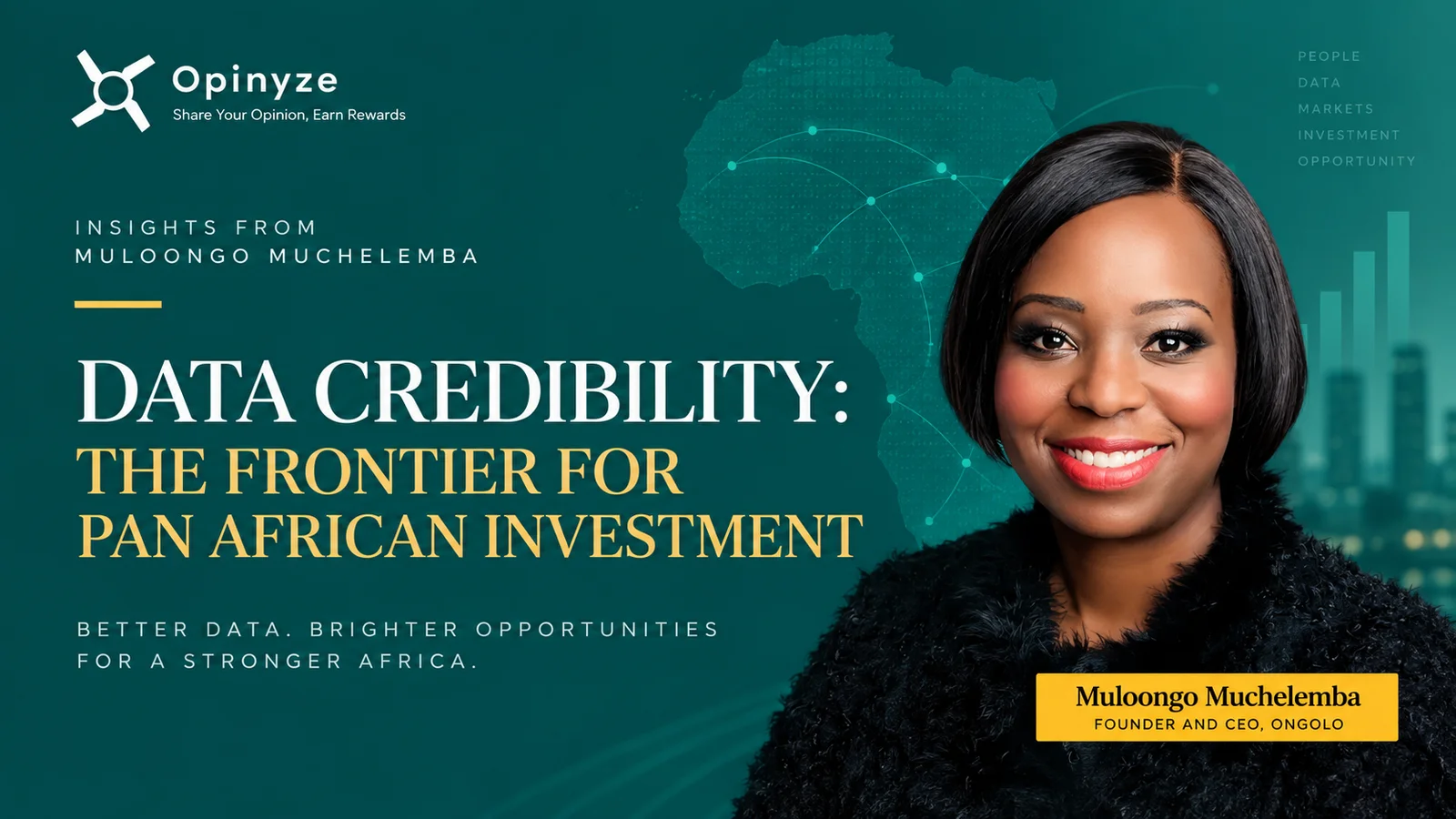
Why credible, accessible and granular data matters for Africa’s investment future A strategic article based on the session with Muloongo, CEO of Ongolo
Babatunde Alli Balogun
Co-Founder, Opinyze
On this page
Executive summary
Core thesis. Africa’s investment challenge is not only a shortage of capital or opportunities. It is also a shortage of credible, current, accessible, and granular information that allows investors to identify, quantify, compare, and price those opportunities with confidence. Muloongo Muchelember, the CEO of Ongolo made a substantial contribution to the discussion, beginning with the statement,
“Africa does not need data to make itself look less risky; it just needs credible data.”
Introduction
Africa’s investment narrative is often dominated by familiar concerns such as infrastructure constraints, currency volatility, regulatory complexity, political uncertainty and limited access to long-term capital. Yet the session with Muloongo surfaced another constraint that is less visible and potentially just as consequential: the quality of information available to investors.
The issue is not simply whether a number is technically correct. A credible dataset must also be complete, consistent, current, relevant, transparent, and capable of independent verification. Muloongo argued that these attributes are central because data forms the foundation on which investors make decisions.
“Data credibility is about accuracy, completeness, consistency, timeliness and transparency.”
1. The investment problem begins before valuation
In a developed market, investors may spend their time debating valuation, competitive positioning, and expected returns. In many African markets, the first challenge can be more basic: establishing what the market actually is.
“In developed markets, investors usually debate or try to find out how much a company’s worth. In Africa, the challenge is more basic than that. We’re trying to find out is there actually a market. And what that market actually is.”
This changes the investment process. Before an investor can value a company, the investor must understand the size and quality of the market it serves. That requires more than a national population figure. It requires evidence about where people live, how household structures are changing, what people earn, what they consume, where businesses are located, how cities are growing, and where new infrastructure demand is emerging.
2. The problem with old data is not that it was wrong
Nigeria provides a useful illustration. Muloongo noted that the 2006 census produced a population figure of about 150 million, while contemporary estimates are considerably higher. Her point was not that the 2006 figure was inaccurate when it was collected. Her point was that an economy can change so materially that historically correct information becomes insufficient for current commercial decisions.
“The data was correct in 2006, but it’s old data.”
Since that census, industries and behaviours have changed dramatically. Mobile money, fintech, e-commerce, urbanisation and renewable energy have all evolved. New residential areas have emerged, and cities have expanded. Consequently, outdated demographic information can distort market sizing, site selection, and demand forecasting.
“Investment decisions are usually forward-looking, but most of our data is backward-looking and sometimes very backward-looking.”
3. Africa competes globally for capital
The data problem becomes even more important because investors are not deciding between African opportunities alone. Africa competes with Latin America, Southeast Asia, Eastern Europe, and other emerging markets for the same pools of global capital.
This introduces an information cost into investment decisions. If an investor can obtain reliable market information quickly in one country but must spend months reconstructing the same information in another, the latter market becomes more expensive to evaluate. The underlying opportunity may still be attractive, but the process of proving that attractiveness becomes harder.
“Why am I spending so much time trying to figure out the data, trying to normalise it, when I can just go and set up shop in Brazil, where the data is available?”
The implication is strategic. Improving data availability can strengthen Africa’s competitiveness for international capital not by changing the underlying opportunity, but by reducing the friction involved in understanding it.
4. Poor information can become a cost of capital problem
One of the most important distinctions in the session was between risk and uncertainty. Risk is something an investor can identify and attempt to price. Uncertainty arises when the evidence is insufficient to quantify the range of possible outcomes with confidence.
“Risk is something I can identify, and I can price it, whereas uncertainty is something I cannot adequately measure.”
When uncertainty is high, investors often compensate. They can demand higher returns, undertake more due diligence, build additional protections into transactions, shorten financing tenors or decide not to proceed. In this sense, weak information can move directly from the data environment into the financial structure of an investment.
“Bad data or lack of data doesn’t mean there’s no opportunity; it just means that investors struggle to price the opportunity.”
This can create a self-reinforcing cycle. Poor information raises uncertainty. Higher uncertainty increases perceived risk. Higher perceived risk raises the cost of capital. A higher cost of capital reduces investment. Lower investment produces fewer transactions and less market evidence, which leaves future investors facing the same information gap.
5. The greatest hidden opportunity may be in what the data does not capture
“Absence of evidence is often interpreted as evidence of absence.”
The statement captures a critical problem in emerging markets. If investors cannot see evidence of demand, they may conclude that demand does not exist. But the absence of evidence may simply mean that the market has not been measured effectively.
This is particularly important where substantial economic activity takes place informally. Informal businesses and low-value, high-frequency transactions can be invisible in conventional statistics, even when they represent significant purchasing power at the aggregate level.
Muloongo gave the example of mobile customers who make many small top-up transactions. A customer who spends a small amount at a time may appear insignificant when viewed through a single transaction. But repeated purchases can create substantial monthly or weekly expenditure. Mobile companies see this because they analyse detailed transactional behaviour.
“The challenge in Africa is that it’s not that opportunities are not investable. It’s just that they’re undocumented.”
6. The informal economy is not necessarily a weak economy
The session challenges a common analytical shortcut: equating low reported income with low commercial potential. In markets where people earn income informally, official records may understate the resources available for consumption.
This matters for industries such as food, beverages, telecommunications, and other fast-moving consumer categories. Their economics can depend on high-frequency transactions, broad customer bases, and low individual ticket sizes rather than a small number of high-value purchases.
For investors, the lesson is to distinguish between low transaction value and low economic significance. Frequency, scale, and network effects can change the commercial picture materially.
7. Granular data matters because countries are not single markets
Watch here on YouTube
“Africa is not a country, and Africa is not one market, and even one country is not the whole market.”
National averages are useful for establishing context but can be inadequate for commercial decisions. Lagos is not necessarily representative of Nigeria. Nairobi is not representative of Kenya. Johannesburg is not representative of South Africa. Abidjan is not representative of Côte d’Ivoire.
The investor needs to know the characteristics of the specific customer and location being targeted. Who is the customer? How much does the customer earn? Can the customer afford the product? What alternative solution does the customer use today? Where are those customers concentrated?
“Population is not the same as addressable market.”
This distinction is central to market sizing. A large population creates potential, but only a particular subset may have the income, preferences, location, access, and willingness to buy a specific product or service.
8. Consumer surveys can fill critical gaps
Muloongo emphasised market surveys as an important complement to censuses and other official statistics. In developed markets, businesses routinely collect customer feedback after transactions. Those surveys generate information about satisfaction, willingness to recommend, future purchases, preferences, and unmet needs.
For African markets, systematic surveys can create a layer of evidence between broad public statistics and highly proprietary corporate data. They can help investors understand not only how many potential customers exist but also why they buy, what prevents purchase, what price they will accept and what problems remain unsolved.
This matters because investors are ultimately seeking businesses that solve problems or satisfy unmet needs.
“What are those needs? That’s the information that we need. What do people want?”
9. Africa already has a private data infrastructure
The session reveals a paradox. Public data may be incomplete or difficult to access, while private organisations already hold rich information about economic behaviour.
Telecommunications companies can observe usage and transaction frequency. Banks can observe payment flows and spending patterns. Retailers can observe purchasing behaviour. Payment companies can observe merchant and consumer activity. These datasets can provide a highly granular view of how markets operate in practice.
The challenge is that such information is generally proprietary. The opportunity is to create responsible mechanisms for converting selected insights into aggregated and anonymised market intelligence without exposing individuals or commercially sensitive information.
“Mobile phone companies have actually got this really rich data about how we behave, but it’s not shared with anybody. And I think that’s where the opportunity lies.”
Muloongo, session transcript
10. Banks and telecommunications companies can help reveal the market
Muloongo described how banking data helped estimate premium fuel market share while she was working for Shell in London. Aggregated card purchase information could show how much was spent on fuel, which customers consistently purchased from a particular company, and which customers appeared to choose a location based on convenience.
The example illustrates a broader principle. Financial institutions and telecommunications companies may already possess answers to many of the consumer questions investors repeatedly ask. The challenge is creating the governance framework, incentives, and safeguards required to share high-level insights responsibly.
11. Universities can act as neutral intermediaries
The session also identified universities and research institutions as potential neutral intermediaries. Private companies may be more comfortable sharing data for research when information can be aggregated, anonymised and independently analysed by an institution without a direct commercial agenda.
Universities can therefore help connect government data, private sector data, survey evidence, and academic research. Their role becomes particularly valuable where policy development is slow, provided that research institutions have adequate funding and analytical capacity.
12. Statistics offices should be treated as economic infrastructure
“Statistics offices that we have in Africa need to be treated as important as infrastructure like roads and rail.”
This is a strong policy proposition. Roads and railways reduce the physical cost of doing business. Reliable statistics reduce the informational cost of doing business. Both influence how efficiently resources can be allocated.
Muloongo argued that statistical institutions should have the mandate and capacity to gather information at both the macro and micro levels. Governments should also make legitimate data readily accessible rather than requiring researchers and investors to rely on personal networks to obtain basic economic information.
“I shouldn’t have to use my network to do that. Like that data should be readily available.”
13. Digital identity is part of the foundation
The discussion also moved to the basic infrastructure required to measure economic activity. Reliable identification systems can support better administrative records, financial inclusion, taxation, service delivery, and economic measurement.
The argument is not simply that everyone needs an identification document. The broader point is that consistent identification can enable multiple systems to produce a more coherent view of economic activity, provided that privacy, cybersecurity, and data protection are properly designed.
“If there’s one recommendation, I’ll be like: Do your ID, make it digital, link it to everything, and then it’ll be easy for you to collect data.”
14. Data credibility does not require one perfect dataset
Investors often work in environments where no single dataset is complete. The appropriate response is not to abandon analysis but to triangulate evidence.
An investor can combine official statistics, company records, bank statements, audited financial statements, tax filings, surveys, industry interviews, and other relevant sources. The goal is to test whether separate sources converge on a consistent conclusion.
“Credibility isn’t about finding one perfect data set. Sometimes, especially in Africa, it’s about having multiple imperfect sources that are all pointing towards the same conclusion.”
This is a practical framework for investment research. Instead of asking which dataset is perfect, the investor asks which evidence is available, where it comes from, how it was produced, what it omits, and whether independent sources support the same conclusion.
15. Three priorities for Africa
Measure better
Muloongo argued for more frequent and more adaptive approaches to measurement. Traditional censuses remain important, but countries can complement them with administrative records and systems that collect information more continuously. This can make economic data more current without relying entirely on large periodic exercises.
Share better
Useful information should move more effectively between institutions. Governments, banks, telecommunications companies, universities and research organisations should explore responsible ways to share aggregated and anonymised information.
Document better
Every important statistic should make its source, collection date, methodology, coverage and limitations clear. Good documentation makes it easier for investors and researchers to assess credibility and reproduce conclusions.
16. What this means for investors
Investors need a more deliberate approach to information quality in African markets. Rather than relying on a single headline statistic, they should build an evidence stack.
Evidence layer | Illustrative questions |
Official statistics | What are the source, collection date, methodology, and coverage? |
Company information | Do audited financial statements, bank statements, and tax filings support the claims? |
Consumer research | Who buys, why do they buy, how often do they buy, and what would change their behaviour? |
Transactional evidence | Do banking, payments, or telecommunications patterns support observed demand? |
Local intelligence | Do interviews with relevant market participants confirm what the published data suggests? |
17. A different way to think about African investment risk
The session suggests that the debate should move beyond the simple question of whether Africa is high risk. A more precise question is how much of the perceived risk is driven by actual economic conditions and how much is driven by uncertainty created by information gaps.
Better data will not eliminate political risk, currency risk, infrastructure constraints, or regulatory uncertainty. It can, however, make those risks more measurable and therefore more manageable.
Just as importantly, better information can reveal opportunities that are currently hidden behind outdated statistics, national averages, informal activity, and limited consumer research.
18. Conclusion
Africa’s data challenge is ultimately an investment challenge. The availability and quality of information influence how markets are sized, businesses are valued, capital is priced, financing is structured, and investment decisions are made.
The solution requires a coordinated ecosystem. Governments need stronger statistical institutions, accessible public data, and better administrative systems. Private companies need frameworks that support responsible sharing of aggregated insights. Universities and research organisations can help provide neutral platforms for analysis. Data platforms can help integrate fragmented information and make it easier to use.
Investors also have a role. They can strengthen their own decision processes by treating data verification and triangulation as core parts of investment analysis rather than as secondary due diligence exercises.
“Africa doesn’t need data to make itself look less risky; it just needs credible data.”
That statement captures the broader opportunity. Africa does not need information designed simply to improve its image. It needs credible information that allows investors to see the continent more accurately, distinguish real risk from uncertainty, identify genuine market demand and discover opportunities that remain invisible today.
Written by
Babatunde Alli Balogun
Co-Founder, Opinyze · Opinyze Research
Keep reading

Discussion (0)
Posting will ask you to sign in. Takes about 20 seconds, your draft is safe.
No comments yet. Be the first to share your take.