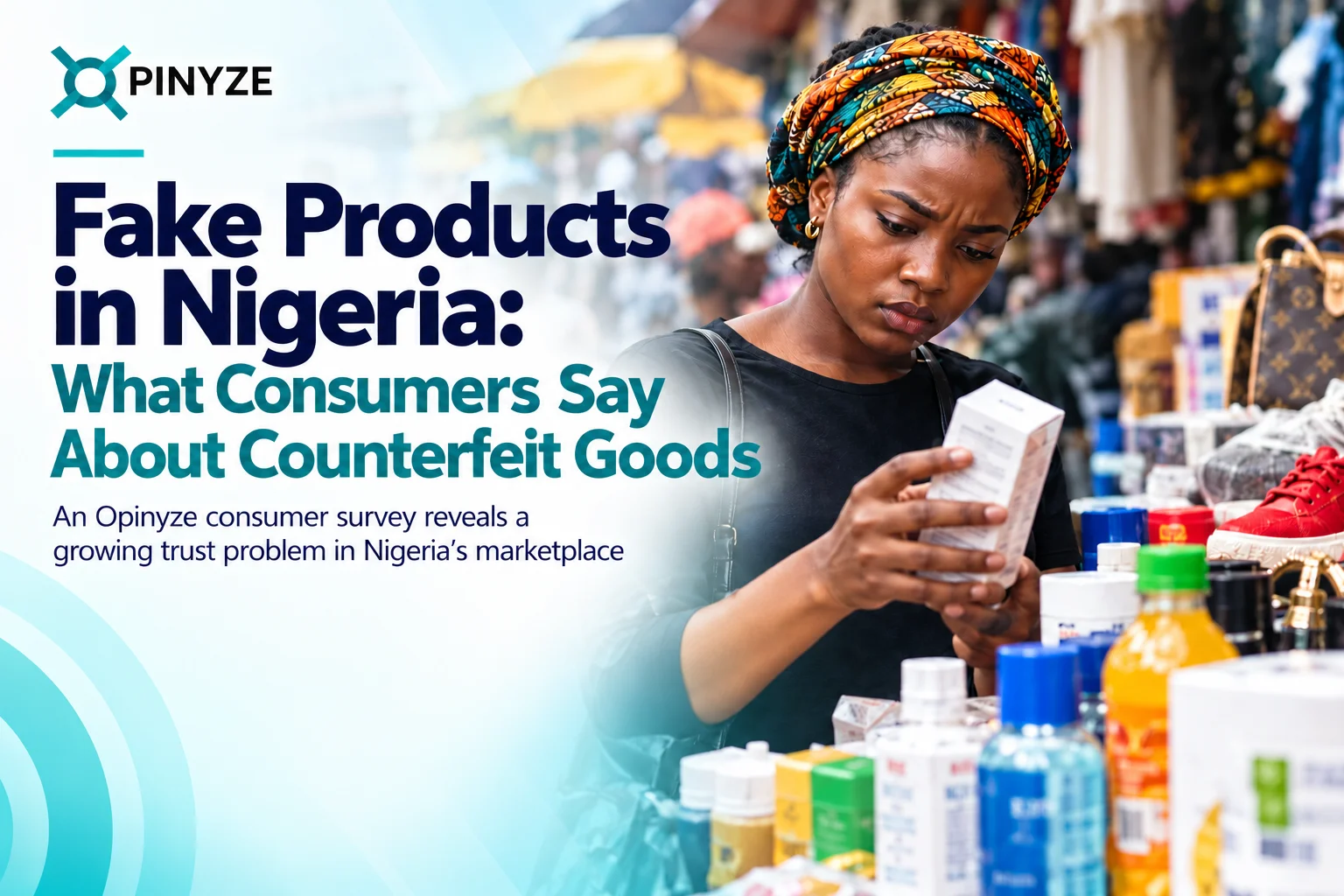
Fake Products in Nigeria: What Consumers Say About Counterfeit Goods
An Opinyze consumer survey explores how Nigerians experience fake products, where suspected counterfeits are purchased, and how confident consumers feel about identifying genuine goods.
Opinyze Team
Opinyze Team
On this page
Walk through an open market, a neighbourhood shop or an online marketplace in Nigeria, and one question can sit quietly behind almost any purchase:
“Is this the real thing?”
For Nigerian consumers, that question now goes well beyond clothes, shoes and electronics. It increasingly concerns products people drink, eat, apply to their bodies and rely on for their health. An Opinyze consumer survey across Nigeria offers a closer look at how people encounter suspected fake products and how they try to protect themselves.
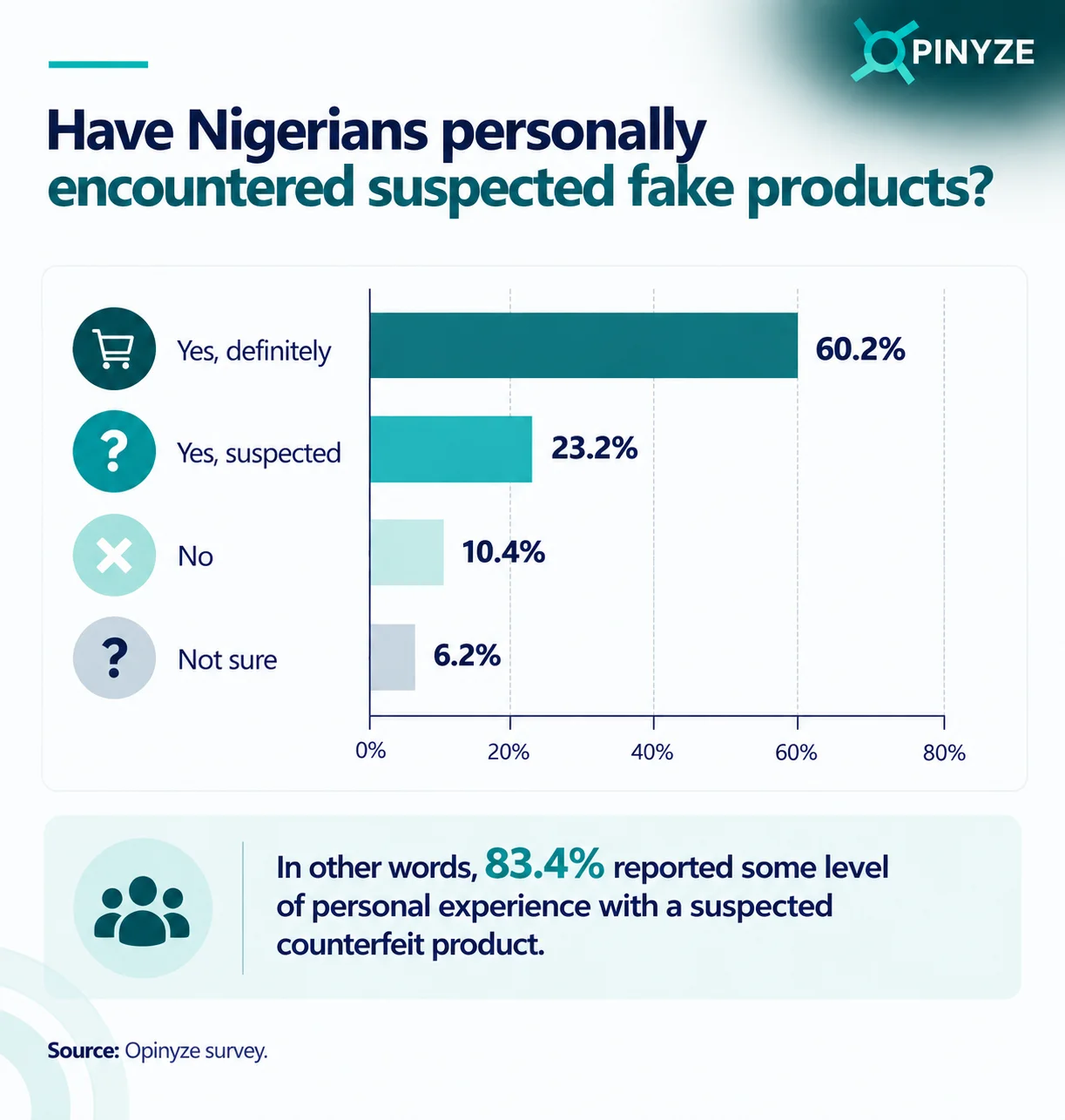
The survey found that 83.4% of respondents had either definitely purchased or suspected they had purchased a fake or counterfeit product. That matters because counterfeit goods are not only a retail problem. Depending on the product, they can also create health, safety and financial risks. The bigger question is whether consumers can reliably distinguish genuine products from fake ones before making a purchase.
Among respondents, 60.2% said they had definitely bought a product they later believed was fake, while 23.2% said they had suspected a purchase was fake. By comparison, 10.4% said they had not experienced this, and 6.2% were unsure.
Which Products Are Most Commonly Reported as Fake in Nigeria?
The survey shows that suspected counterfeiting reaches far beyond fashion and electronics. Drinks were the most frequently reported category at 39.8%, followed by cosmetics and skincare (35.7%), medicine (27.0%) and food (26.6%). Electronics and toothpaste/oral care each recorded 19.1%, while clothing and shoes accounted for 18.7%.
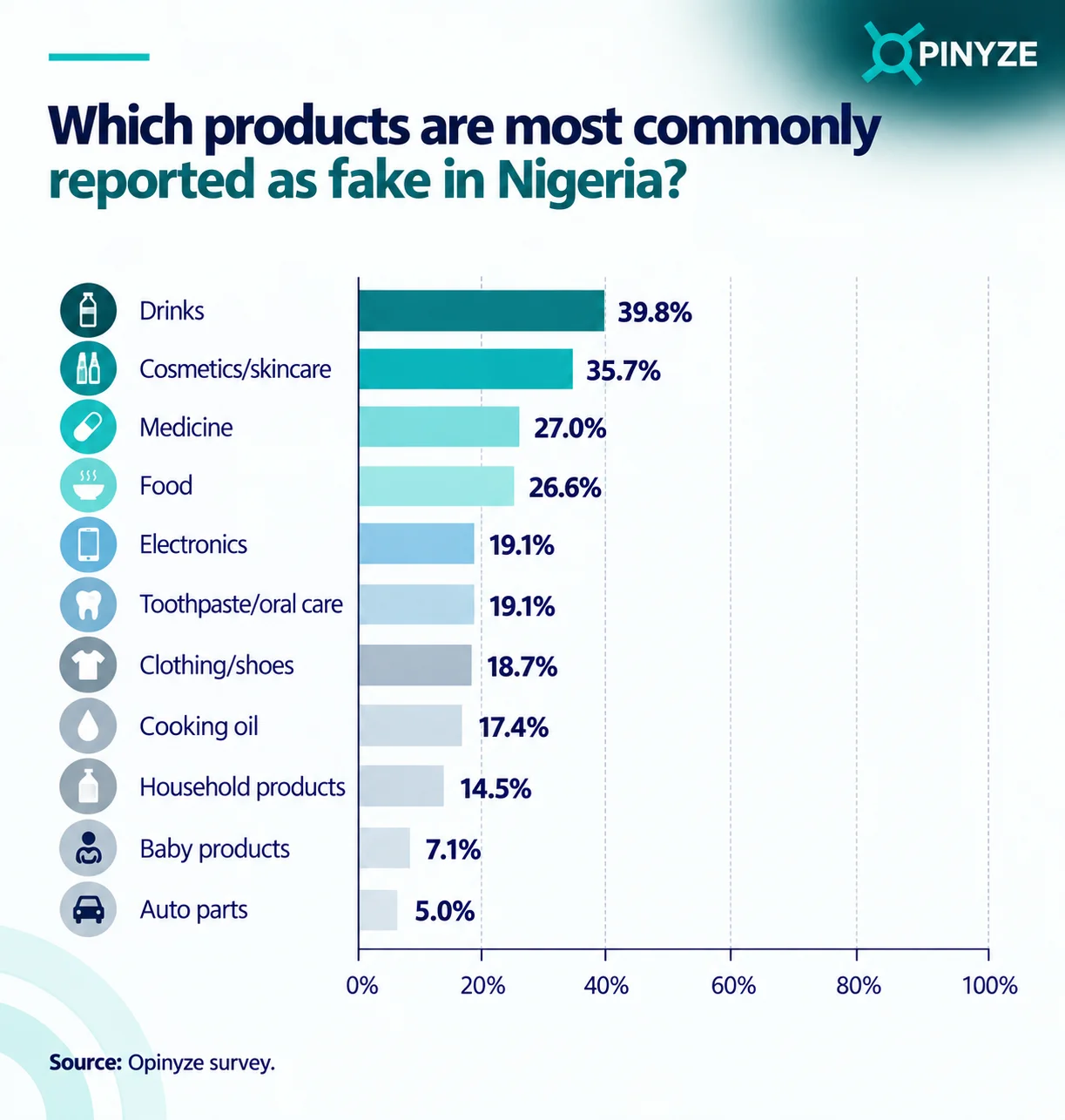
When people hear “fake product”, they may picture an imitation handbag, shoe or phone. The Opinyze findings point to a wider consumer-safety issue. People also reported suspected counterfeits in categories that can have direct consequences for health, including drinks, cosmetics, medicine and food.
This concern aligns with the focus of NAFDAC’s 2024–2027 strategic plan, which identifies reducing substandard and falsified or counterfeit medical products, unwholesome foods and other regulated products as a strategic objective. The plan also emphasises stronger post-market surveillance.
Where Are Nigerians Buying Suspected Fake Products?
The answer matters because counterfeit control does not end at the border or at the point of importation.
Among respondents who reported a suspected counterfeit purchase, the open market was the most frequently mentioned location at 39.8%. Street vendors followed at 16.6%, while small retail shops accounted for 15.8%. Supermarkets, online marketplaces and pharmacies also appeared in the responses.
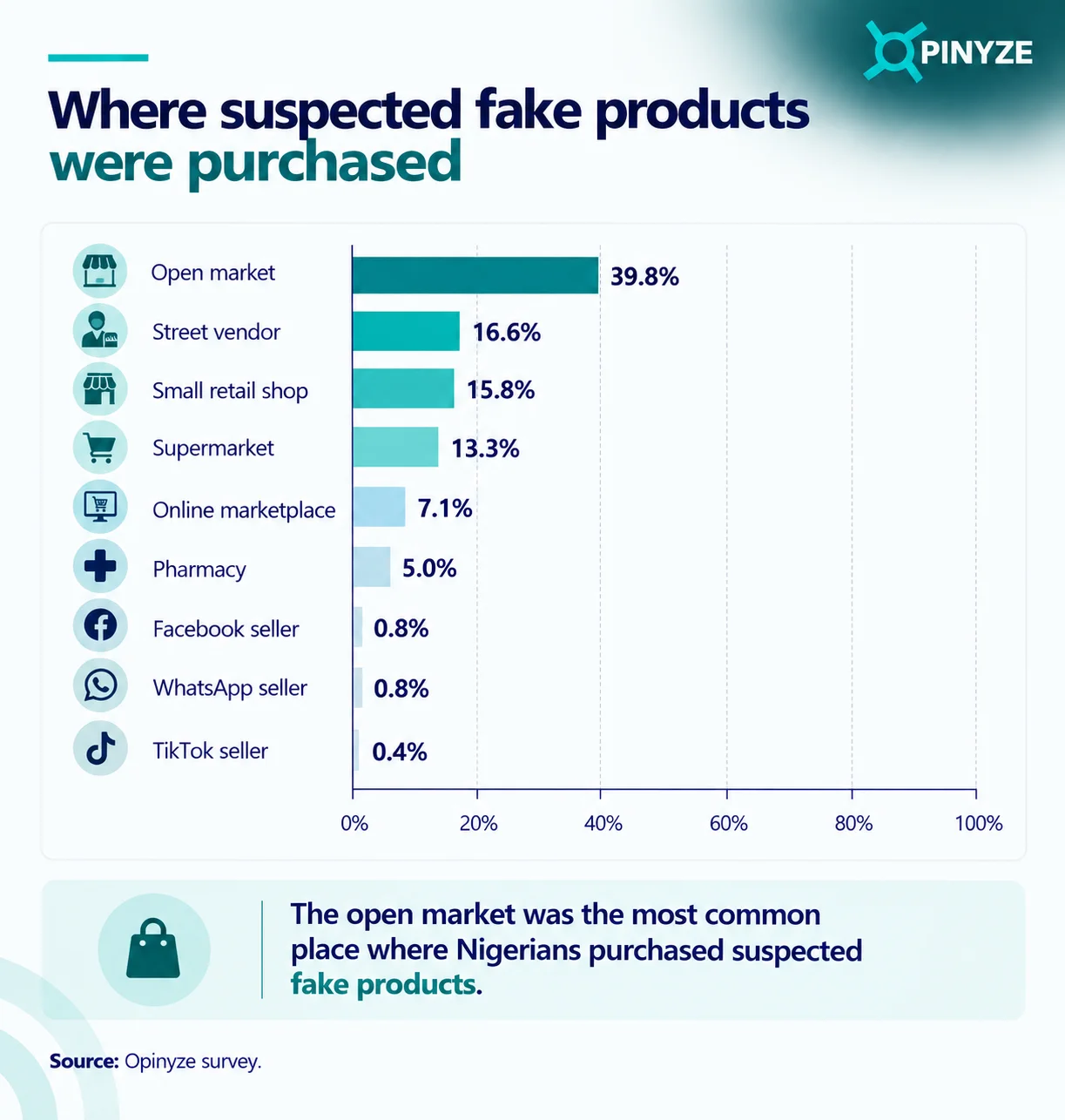
The pattern helps explain why market-level enforcement matters. SON says its compliance activities include market surveys, surveillance, investigation, seizure and destruction of products confirmed to be substandard or fake. It also monitors both locally manufactured and imported products.
In practical terms, the fight against counterfeit products continues inside the marketplace. Consumers need accessible ways to verify what they are buying, while regulators and businesses need reliable information about where suspicious products are entering the supply chain.
Nigerians Are Checking Products, But Can They Tell What Is Genuine?
One of the clearest findings is the gap between checking and confidently identifying a fake. Almost half of respondents, 46.9%, said they definitely check whether a product is fake when buying it.
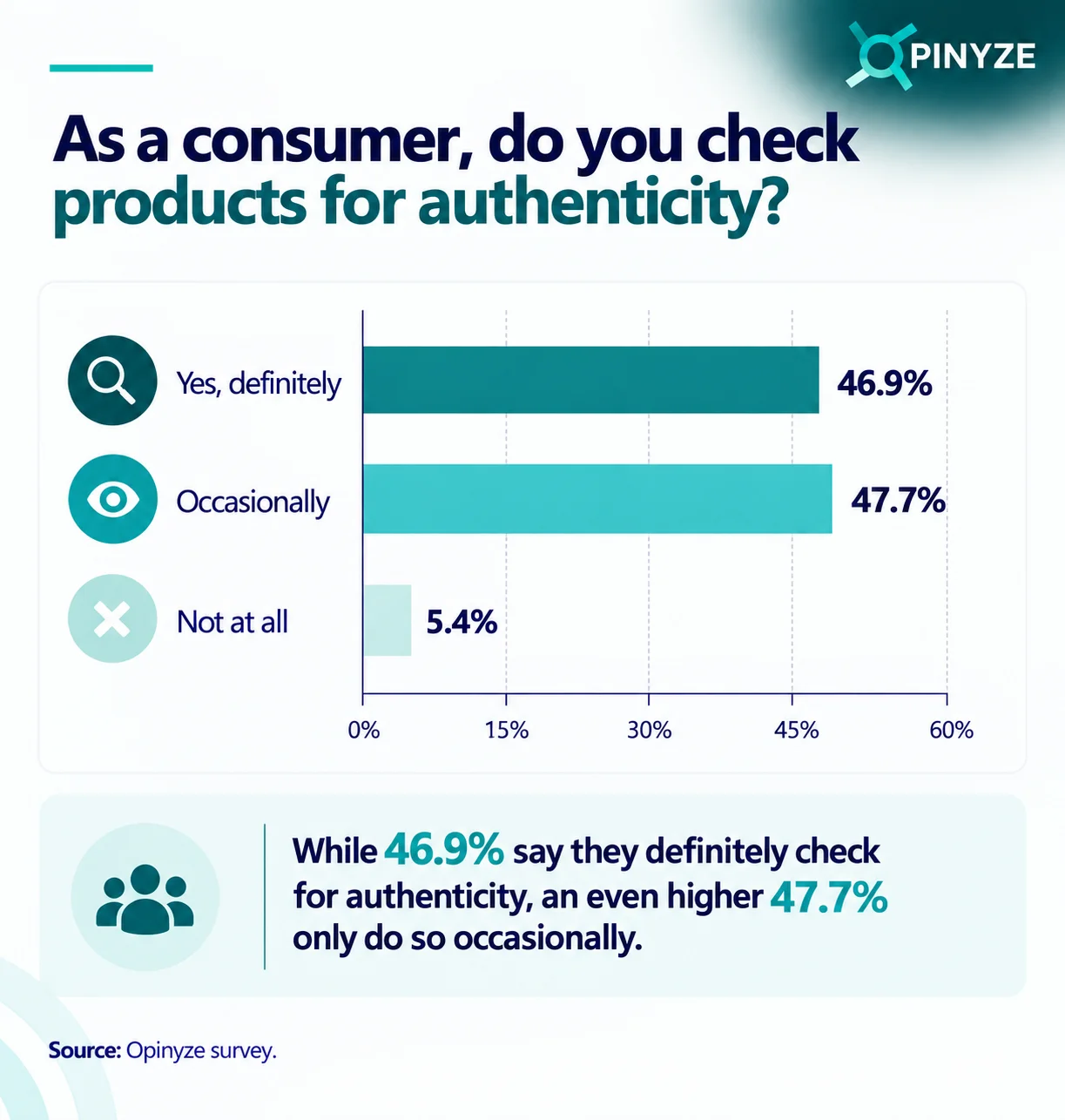
That sounds encouraging until it is considered alongside another finding:
39.5% of respondents said most people cannot spot fake products. In other words, many consumers are trying to check products without feeling certain that their checks are enough.
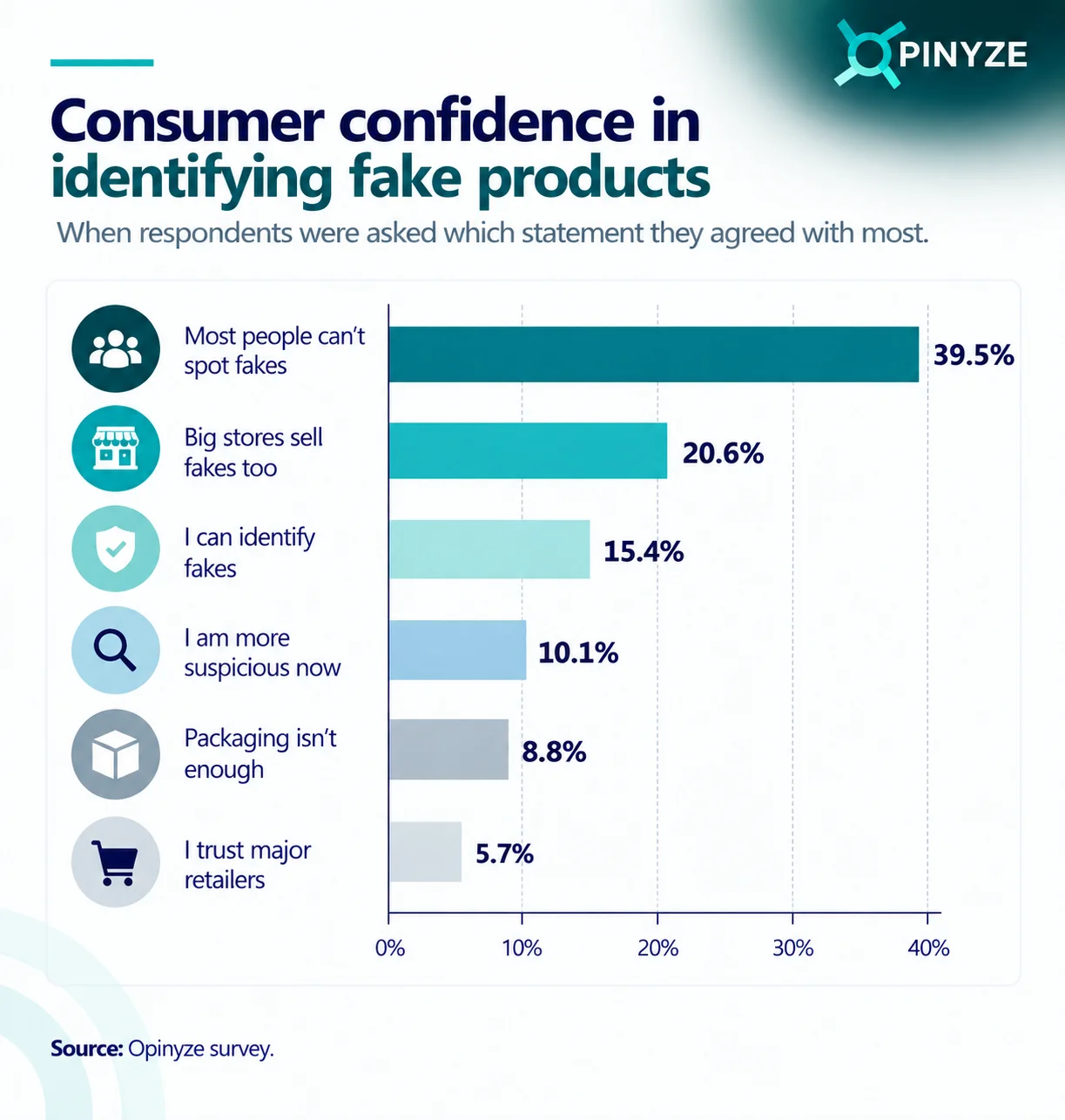
Checking a product is not the same as proving that it is genuine. A consumer can examine a label, compare packaging, look at the price or inspect the product itself and still be unsure.
Respondents described several clues that trigger suspicion, showing how heavily consumers can depend on visible or sensory signals.
Common warning signs included unusual packaging, changes in taste, poor performance, differences in colour, unusual texture or smell, questionable expiry information, unusually low prices and warnings shared on social media.
The timing is important. If a consumer only notices something is wrong after the product has been opened, consumed or used, the risk has already been taken. That is why product authentication and traceability are important: the goal is to provide a reliable signal before the harm occurs.
SON says its Product Authentication Mark is designed to help consumers verify the genuineness of certified products and improve traceability. NAFDAC also provides an online way to verify registered products using NAFDAC registration numbers. The remaining challenge is making these systems simple, visible and widely used by everyday consumers.
Would Nigerians Buy a Cheaper Fake?
Price is often presented as the reason people buy counterfeit goods. The survey suggests the decision is more complicated than that.
Asked whether they would knowingly buy a fake if it were significantly cheaper but appeared to work like the original, 46.9% said no, while 34.0% said their decision would depend on the circumstances.
The result suggests that affordability matters. Though for many consumers, the decision appears to involve a calculation between price, perceived risk and the importance of the product. A person may be willing to take a chance on an imitation fashion item. But that calculation becomes very different when the product is medicine, baby food, cooking oil or something applied directly to the body.
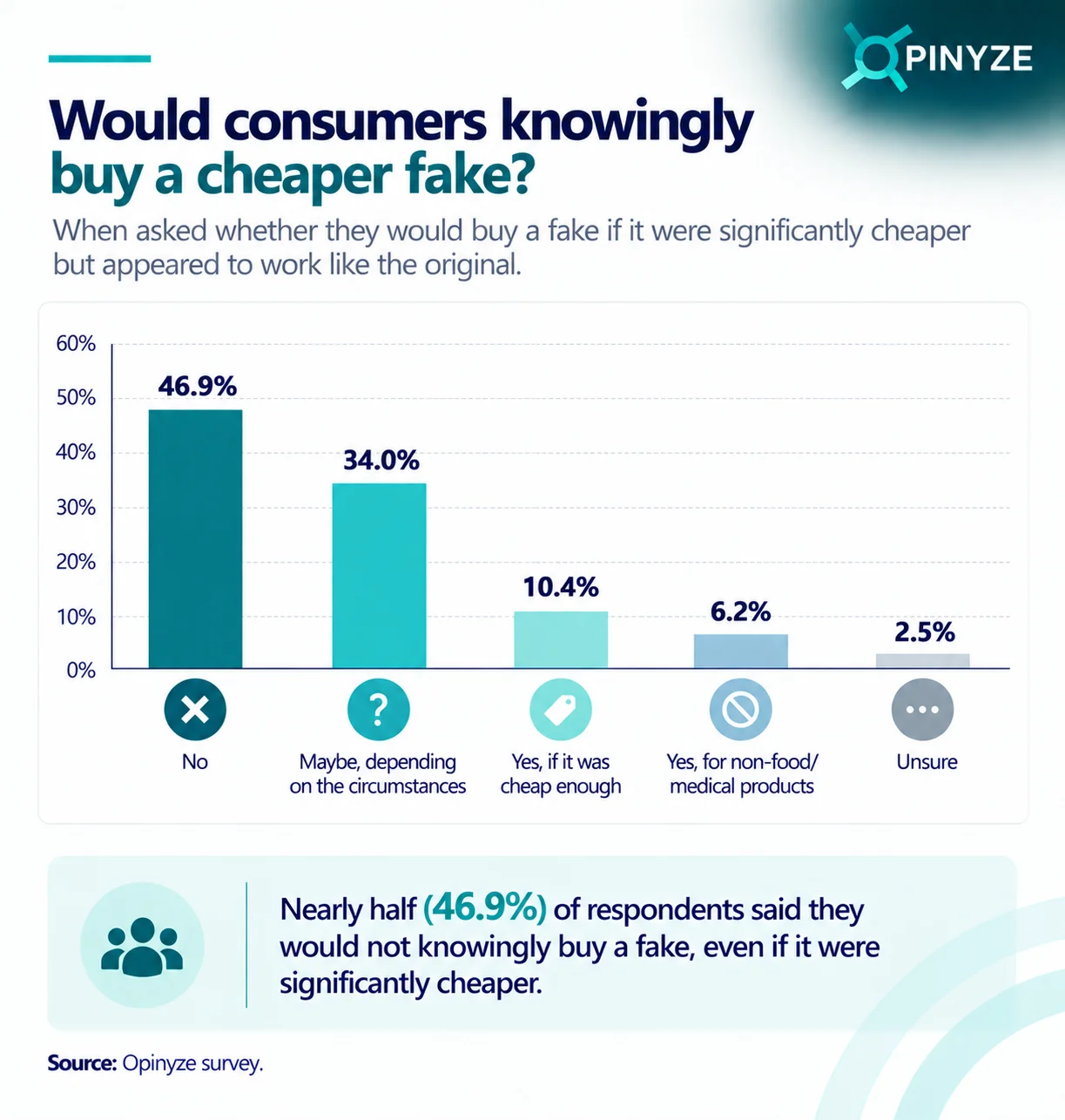
The result suggests that affordability matters, but so do perceived risk and the importance of the product. Consumers may view a cheap imitation differently when it is a fashion item than when it is medicine, baby food, cooking oil or a product applied directly to the body.
Who Do Nigerians Hold Responsible for Fake Products?
Consumers were also asked who they believe is most responsible for fake products reaching the market.
Manufacturers and importers were the most frequently selected at 33.2%. Customs authorities followed at 16.6%, while 15.8% said responsibility should be shared by everyone involved. Regulatory agencies were identified by 13.3%, distributors by 10.4%, retailers by 5.0% and online sellers by 4.6%. Only 1.2% identified consumers as primarily responsible.
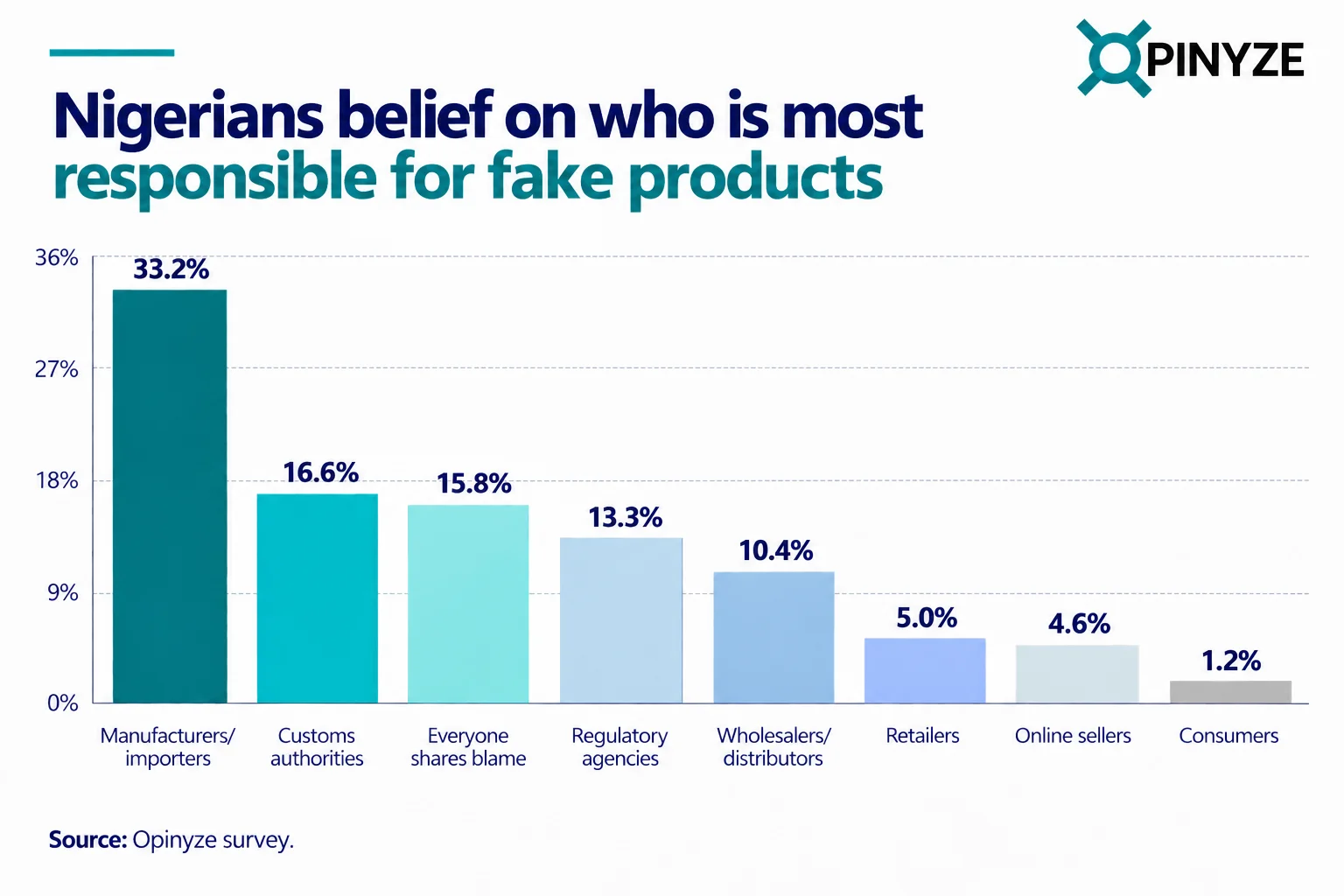
These responses are perceptions, not findings from an investigation. Even so, they reveal how consumers understand the counterfeit-products problem: as a chain involving manufacturers, importers, distributors, retailers, border authorities and regulators rather than simply a result of consumers choosing cheaper goods.
That perception broadly reflects the responsibilities already distributed across the regulatory system. SON’s mandate includes product certification, registration, import conformity assessment, market surveillance and product authentication. NAFDAC regulates products including medicines, food, cosmetics and medical devices, with surveillance and enforcement forming part of its approach.
Trust in Nigerian Regulators Remains Mixed
The Opinyze survey also asked respondents to rate their trust in Nigerian regulatory agencies on a scale of one to five.
The largest group, 40.2%, selected the middle rating of three. Meanwhile, 36.5% gave ratings of 1 or 2, compared with 23.2% who gave ratings of 4 or 5.
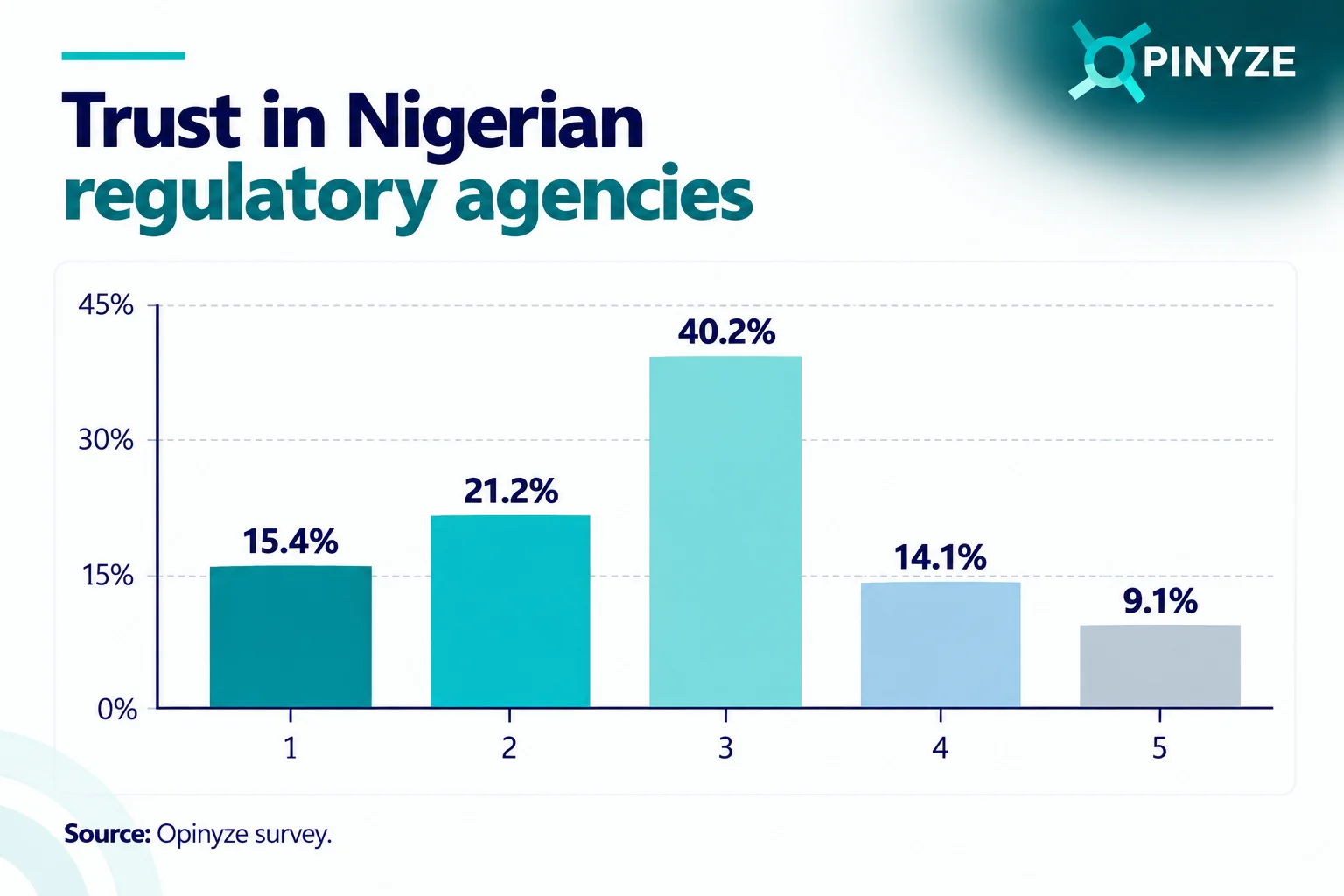
This suggests that confidence is mixed rather than overwhelming. That distinction matters because enforcement works better when consumers know where to get reliable information, trust what they find and feel able to report suspicious products.
Regulation, therefore, is about building a verification system that consumers can understand and trust. There are already signs of that shift. NAFDAC’s Automated Product Administration and Monitoring System allows consumers to verify registered products using registration numbers, while its Greenbook provides a searchable database of registered products.
NAFDAC also provides a mechanism for reporting suspected substandard or falsified medical products. SON operates product certification and authentication systems intended to improve traceability and help consumers verify certified products.
Digital verification will not eliminate counterfeiting by itself. It can, however, make it easier to verify registrations, trace products and identify where problems enter the supply chain. For consumers, the most useful system is one that turns “I am suspicious” into “I can verify this before I buy.”
Key takeaways
• 46.9% said they definitely check products for authenticity, yet 39.5% said most people cannot spot fake products.
• The open market was the most frequently mentioned purchase location (39.8%).
• Drinks (39.8%), cosmetics/skincare (35.7%) and medicine (27.0%) were among the most reported categories.
• 83.4% of respondents reported some level of personal experience with a suspected counterfeit product.
Behind this story
Explore the data yourself
Written by
Opinyze Team
Opinyze Team · Opinyze Research
Keep reading
Related stories
Get the next report first
One email when we publish new data on what Africa thinks. No noise.
Discussion (0)
Posting will ask you to sign in. Takes about 20 seconds, your draft is safe.
No comments yet. Be the first to share your take.