Africa’s AI Readiness Gap: 900 Million Offline and Only 5% of Data Centres AI-Ready
Africa could gain up to $1 trillion from AI by 2035. Explore the data on adoption, infrastructure, jobs, data and AI governance.
Opinyze Research
Editorial team
On this page
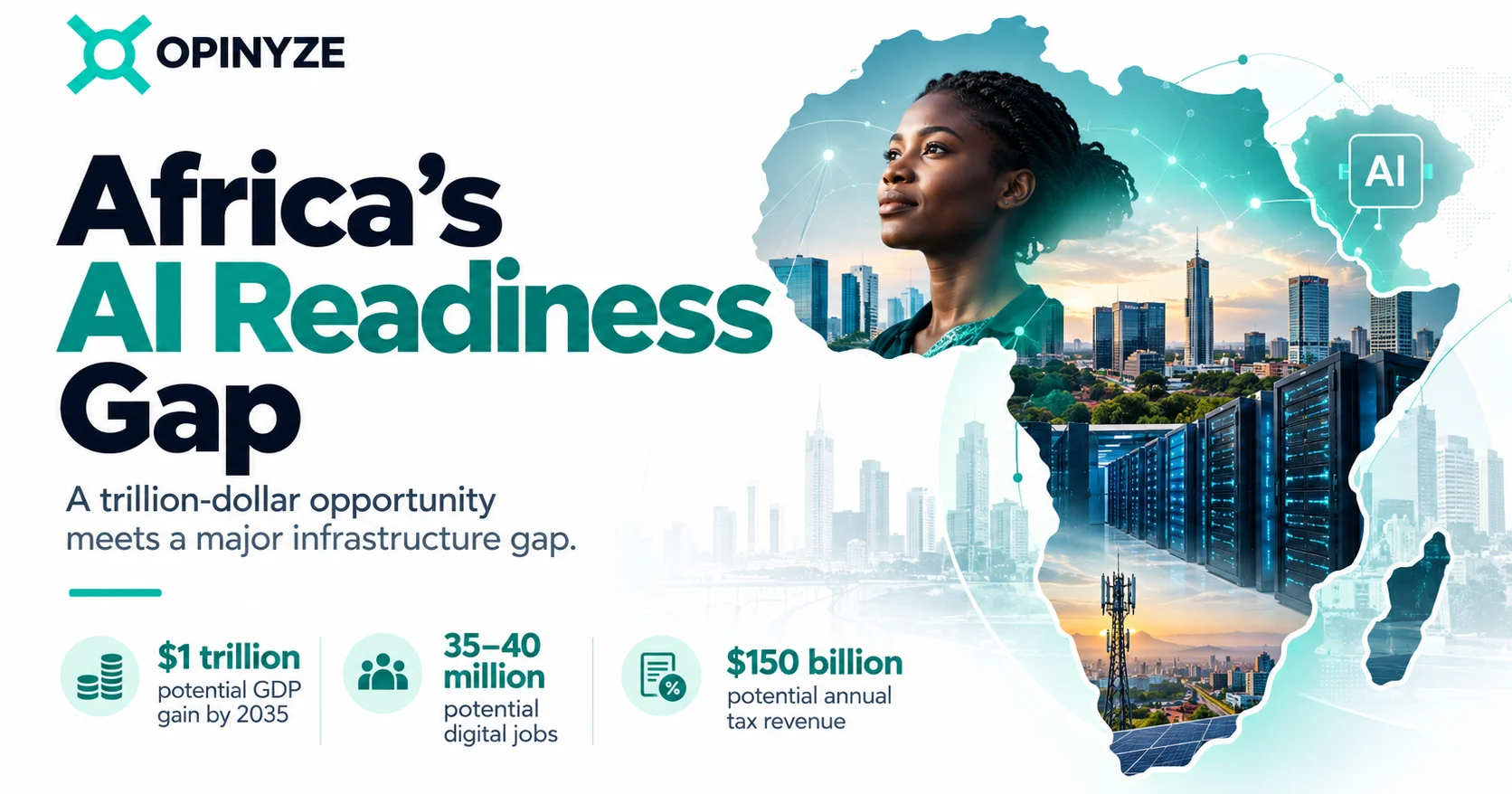
Artificial intelligence could become one of Africa’s biggest sources of economic growth. The opportunity is enormous and the readiness gap is equally clear.
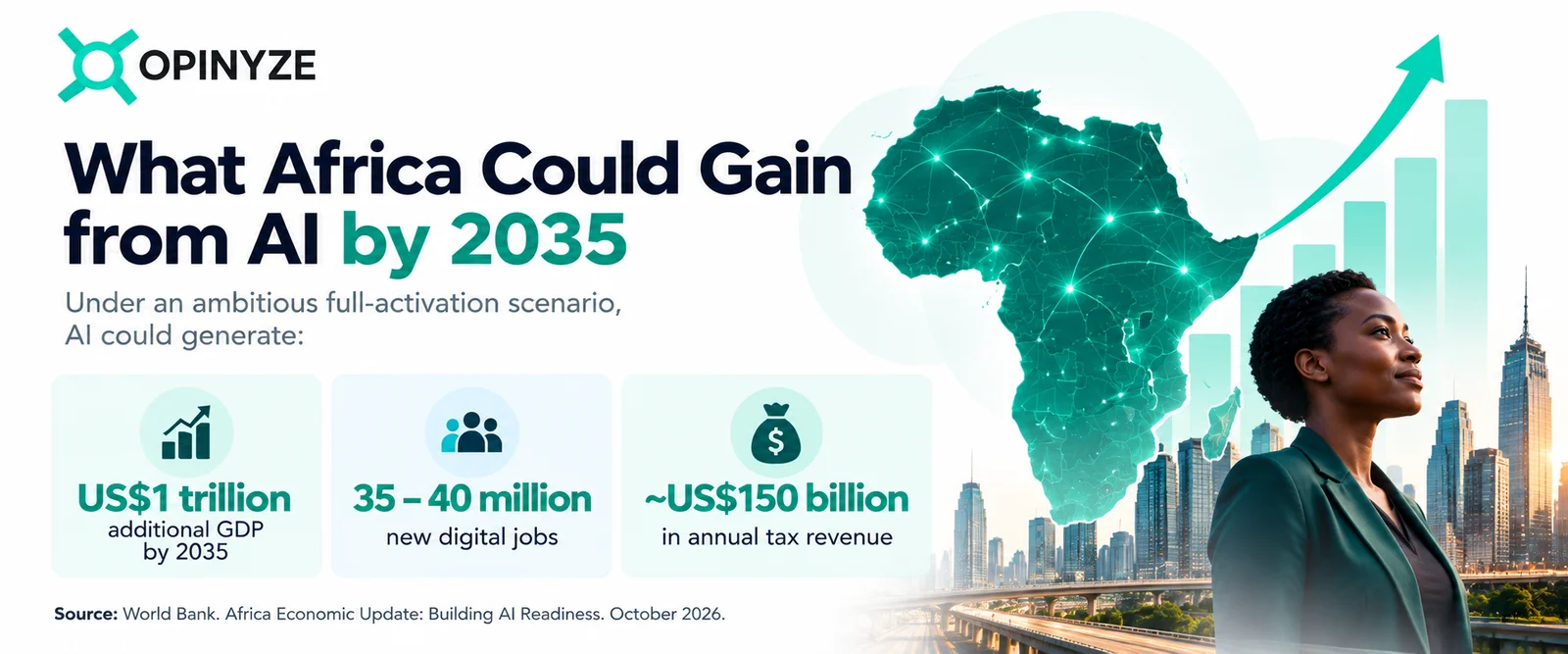
The World Bank’s October 2026 Africa Economic Update: Building AI Readiness estimates that, under an ambitious full-activation scenario, AI could add up to US$1 trillion to Africa’s GDP by 2035, create 35 million to 40 million digital jobs and generate almost US$150 billion in annual tax revenue.
The challenge is turning that potential into productive use.
How Much Could AI Add to Africa’s Economy?
The World Bank presents a wide range of possible outcomes.
Under current AI preparedness levels, AI could add only about 0.2 percentage point to cumulative GDP over the next decade.
With broader and faster adoption, the cumulative gain could reach 4%. The difference shows how strongly Africa’s AI opportunity depends on infrastructure, skills, data, computing capacity and institutional strength.
The US$1 trillion scenario represents an ambitious full-activation scenario. It assumes major improvements across critical AI enablers, including data, computing capacity, skills, trust and capital.
The message is clear: Africa has a huge AI opportunity, but the size of the eventual economic gain will depend on how quickly the continent can build the foundations required to use AI at scale.
AI Adoption Is Growing Across African Businesses
AI adoption is already gaining ground across Africa, particularly in Kenya, Nigeria and South Africa. These countries account for much of the region’s AI innovation and activity.
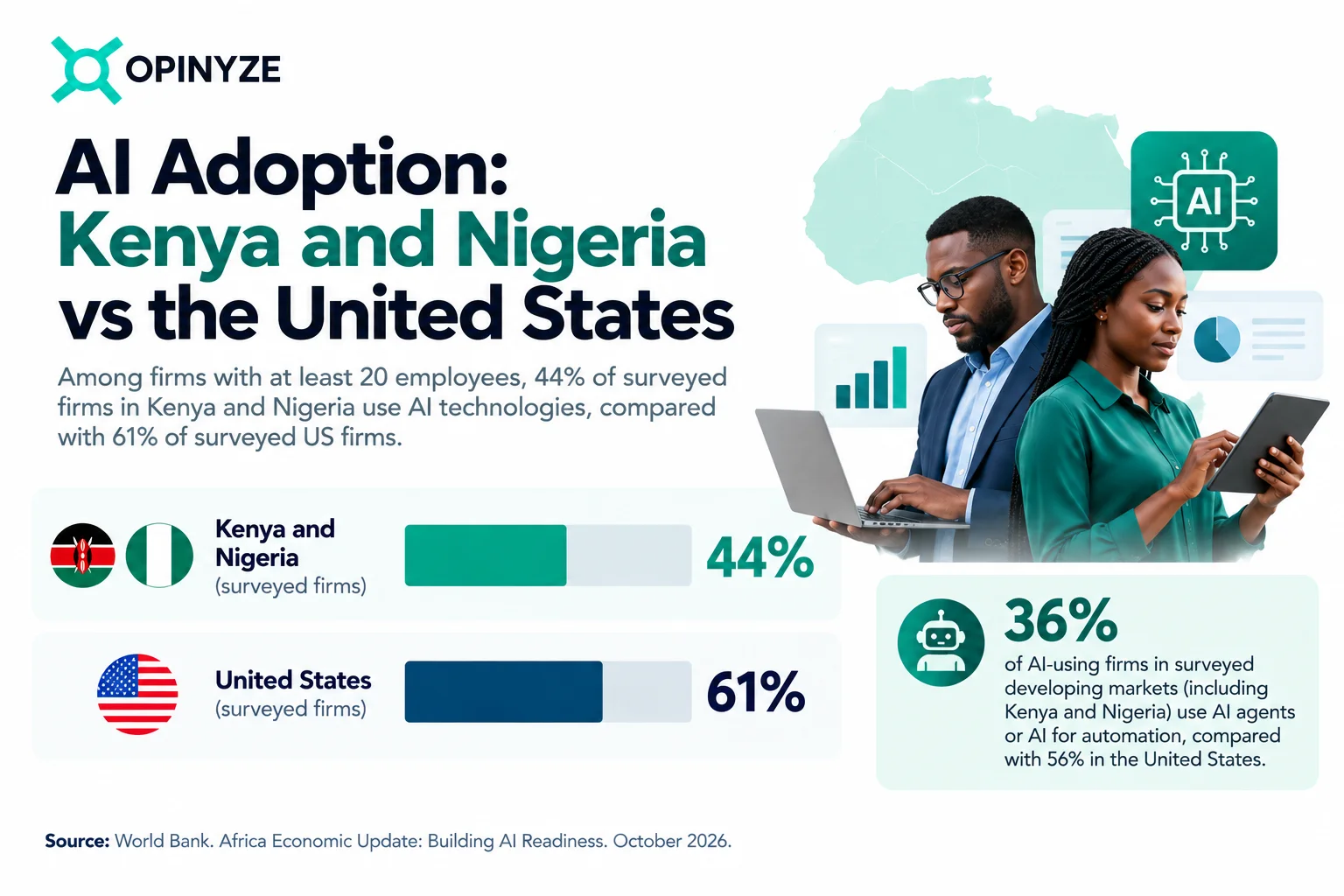
Among firms with at least 20 employees, 44% of surveyed firms across Kenya and Nigeria reported using AI technologies, compared with 61% of surveyed US firms.
The gap becomes more significant when looking at advanced applications.
Among AI-using firms, 36% in the surveyed developing markets used AI agents or AI for automation, compared with 56% in the United States.
This suggests that access to AI is expanding faster than deep business integration.
African companies are adopting AI, but many still have room to move from basic usage towards more sophisticated applications that improve productivity, automation and decision-making.
The Biggest Barrier Is Infrastructure
About 900 million Africans remain offline, while around 200 million lack broadband coverage.
Mobile broadband networks now cover about 95% of the population in Sub-Saharan Africa, up from roughly 50% in 2015. 4G coverage has also increased from below 20% to 83%.
The computing gap is even more striking.
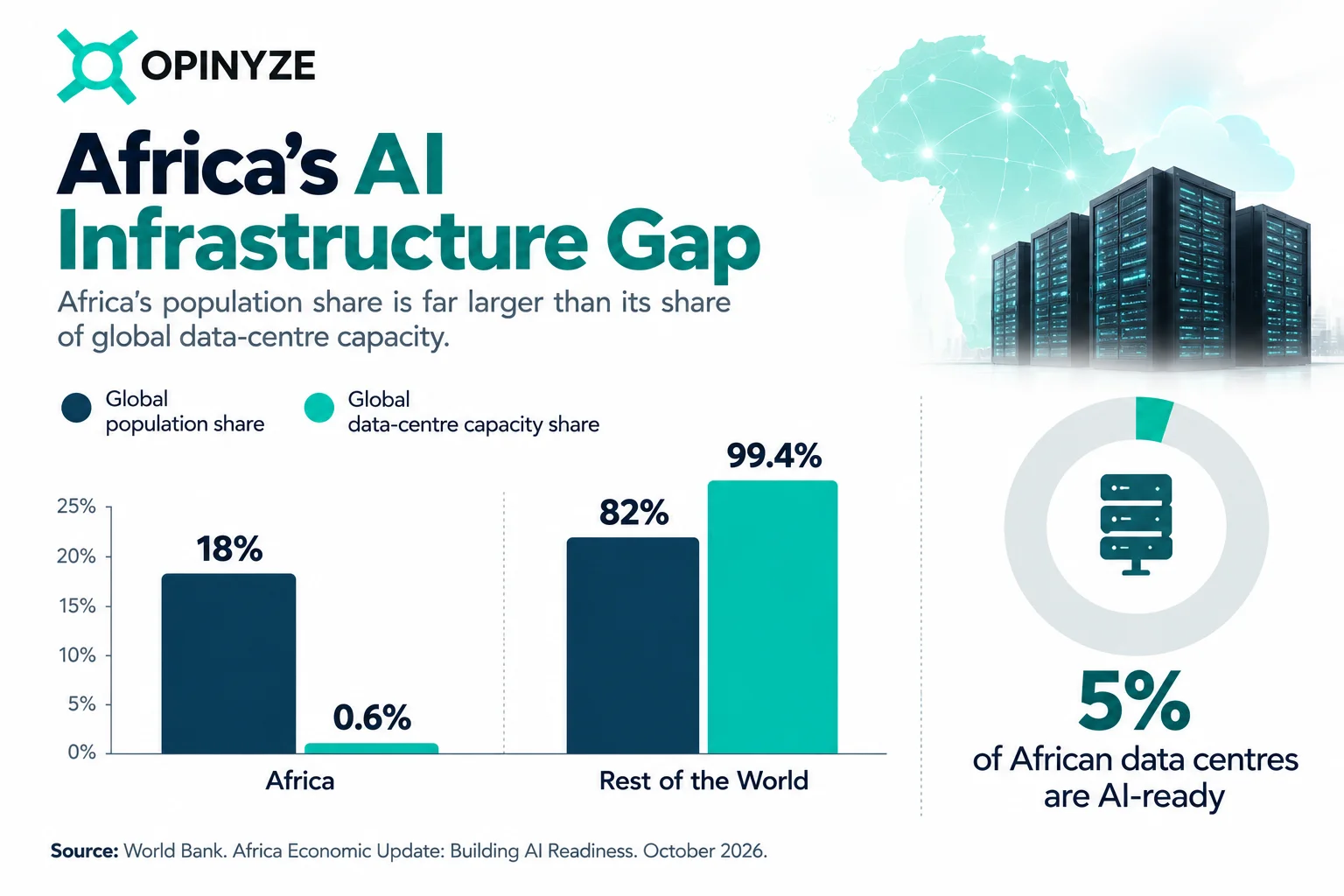
Africa represents nearly 18% of the world’s population, yet accounts for only 0.6% of global data-centre capacity.
Only about 5% of African data centres are currently AI-ready, meaning they can support the high-power requirements of advanced AI workloads.
The implication is straightforward:
AI requires more of electricity, connectivity and computing infrastructure than just softwares.
Africa Also Has a Data Problem
Africa contributes only about 2% of global AI training data.
The language gap is particularly important. The World Bank notes that Swahili has around 710 Hugging Face datasets, compared with 88,844 for English.
This matters because AI systems learn from data.
When African languages, consumers, businesses and local environments are underrepresented in datasets, AI systems can struggle to reflect local needs and contexts.
This creates a growing opportunity for African companies and institutions working on local data, language technology and market intelligence.
AI Could Augment More Jobs Than It Replaces
The employment debate around AI often focuses on job losses.
The data presents a more balanced picture.
The World Bank estimates that the near-term automation risk in Sub-Saharan Africa covers about 2.6% of jobs.
The potential for worker augmentation is much higher at 15.2%.
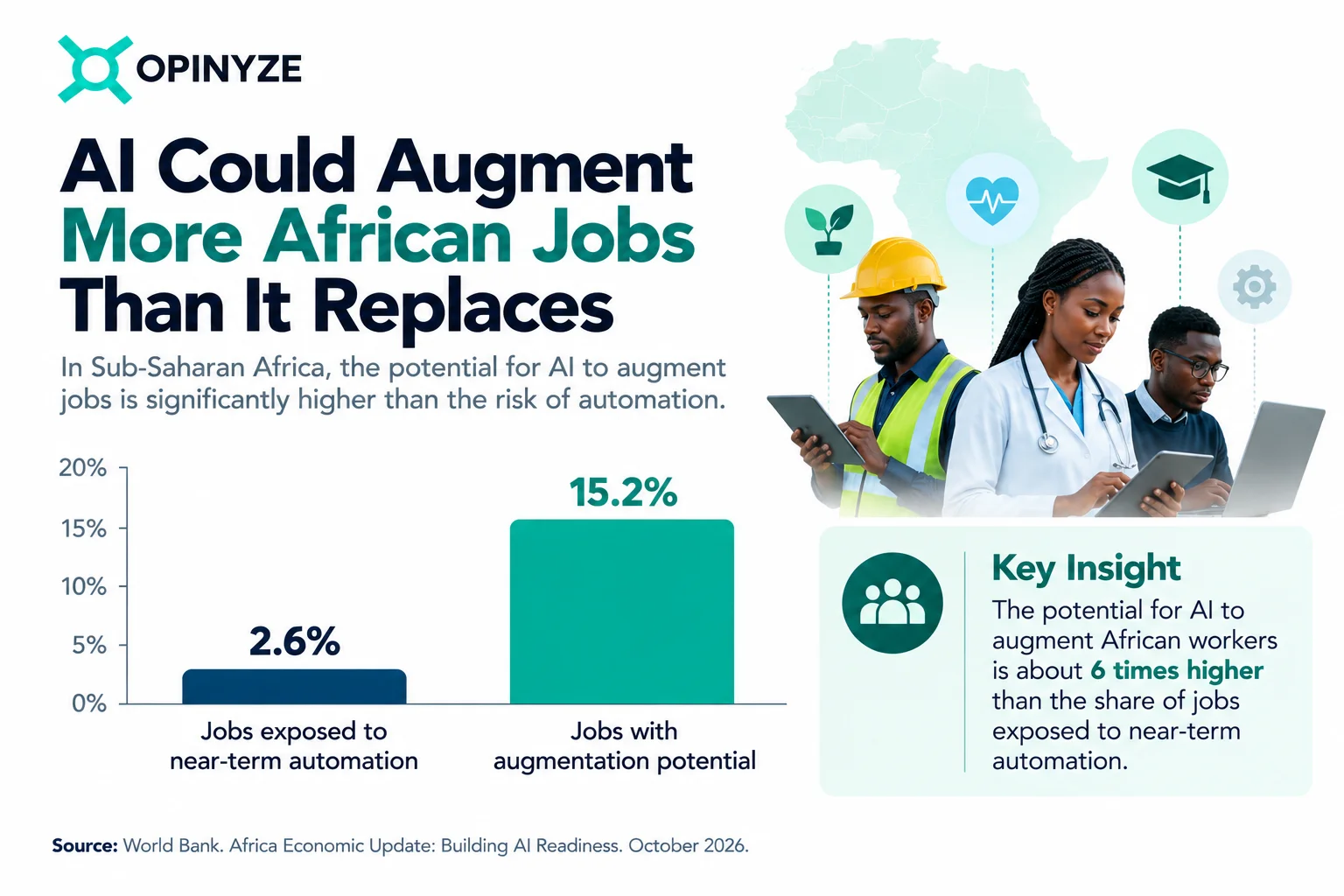
For Africa, this means the immediate value of AI may come less from replacing workers and more from helping them work faster, make better decisions and improve productivity.
This is particularly important in economies where large numbers of people work in agriculture, informal services and manual occupations.
Governance Will Shape How AI Scales
Infrastructure creates the capacity to deploy AI. Governance creates the framework for using it responsibly.
Sub-Saharan Africa scores an average of 41.6 out of 100 on the AI governance pillar, compared with a global average of 52.6. Scores across the region range from 2.25 to 78.75.
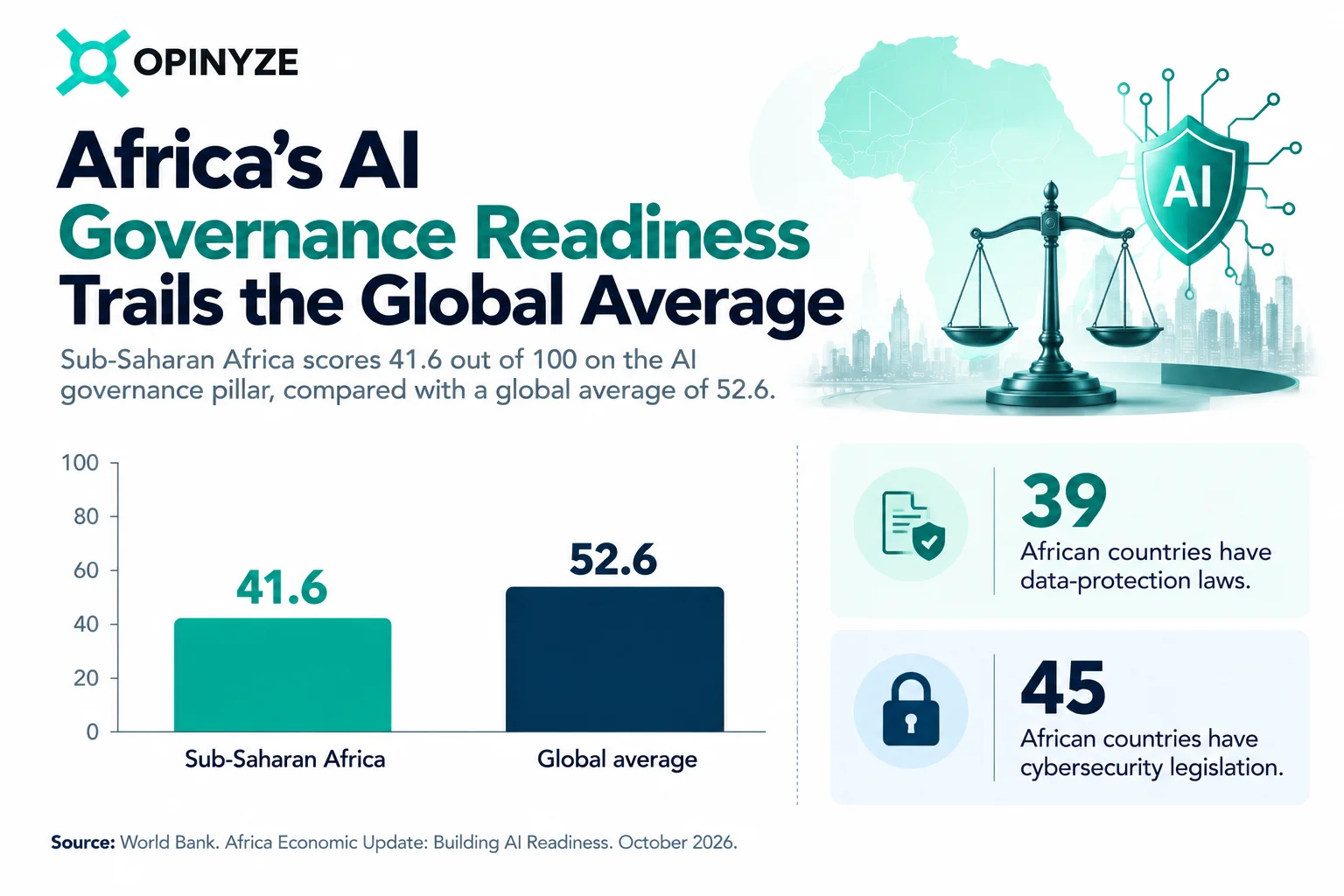
The region has made progress. 39 countries have data-protection laws, while 45 have cybersecurity legislation. However, the World Bank highlights implementation capacity as a major difference between countries.
For businesses, this matters because trust is part of the AI economy.
Companies need reliable rules around data, privacy, cybersecurity, accountability and automated decision-making.
What Africa Needs to Capture the AI Opportunity
The data points to five major priorities:
Reliable electricity
AI infrastructure requires dependable power.
Affordable connectivity
Hundreds of millions of people remain disconnected.
Computing infrastructure
Africa’s data-centre capacity remains far below the continent’s population and economic potential.
Skills and local data
AI adoption requires people who can use, adapt and build AI systems, supported by data that reflects African markets and languages.
Effective governance
Strong institutions and clear frameworks will be essential for trust and sustainable AI adoption.
The World Bank identifies practical, low-cost AI applications in areas such as education, agriculture, health, finance, logistics and public administration as important near-term opportunities for Africa.
The Bigger Data Story
The numbers reveal a major contradiction.
Africa represents nearly 18% of the world’s population, but has only 0.6% of global data-centre capacity.
AI could potentially add US$1 trillion to Africa’s economy by 2035, yet around 900 million Africans remain offline.
Only 5% of African data centres are AI-ready, while the continent contributes only about 2% of global AI training data.
These numbers point to the central issue facing Africa’s AI economy:
The opportunity is growing faster than the infrastructure needed to capture it.
Read our Opinyze analysis on Africa’s data gap to understand how limited access to reliable, local data affects businesses, research and AI development across the continent.
The next phase of Africa’s AI story will therefore depend on how quickly governments, businesses and investors can close the gaps in connectivity, electricity, computing, skills, data and governance.
For African businesses and policymakers, the most important question is no longer whether AI will matter.
It is:
How ready is Africa to turn AI adoption into productivity, jobs and economic value?
Source
World Bank. (2026). Africa Economic Update: Building AI Readiness. October 2026.
Written by
Opinyze Research
Editorial team
Keep reading
Related stories

Get the next report first
One email when we publish new data on what Africa thinks. No noise.
Discussion (0)
Posting will ask you to sign in. Takes about 20 seconds, your draft is safe.
No comments yet. Be the first to share your take.