Nigeria Credit Rating: UN Report Reveals $74.5bn Annual Loss
A UN report shows inaccurate credit ratings cost African nations $74.5 billion yearly in inflated interest. Here is how Nigeria and AfCRA are responding.
Opinyze Research
Editorial team
On this page
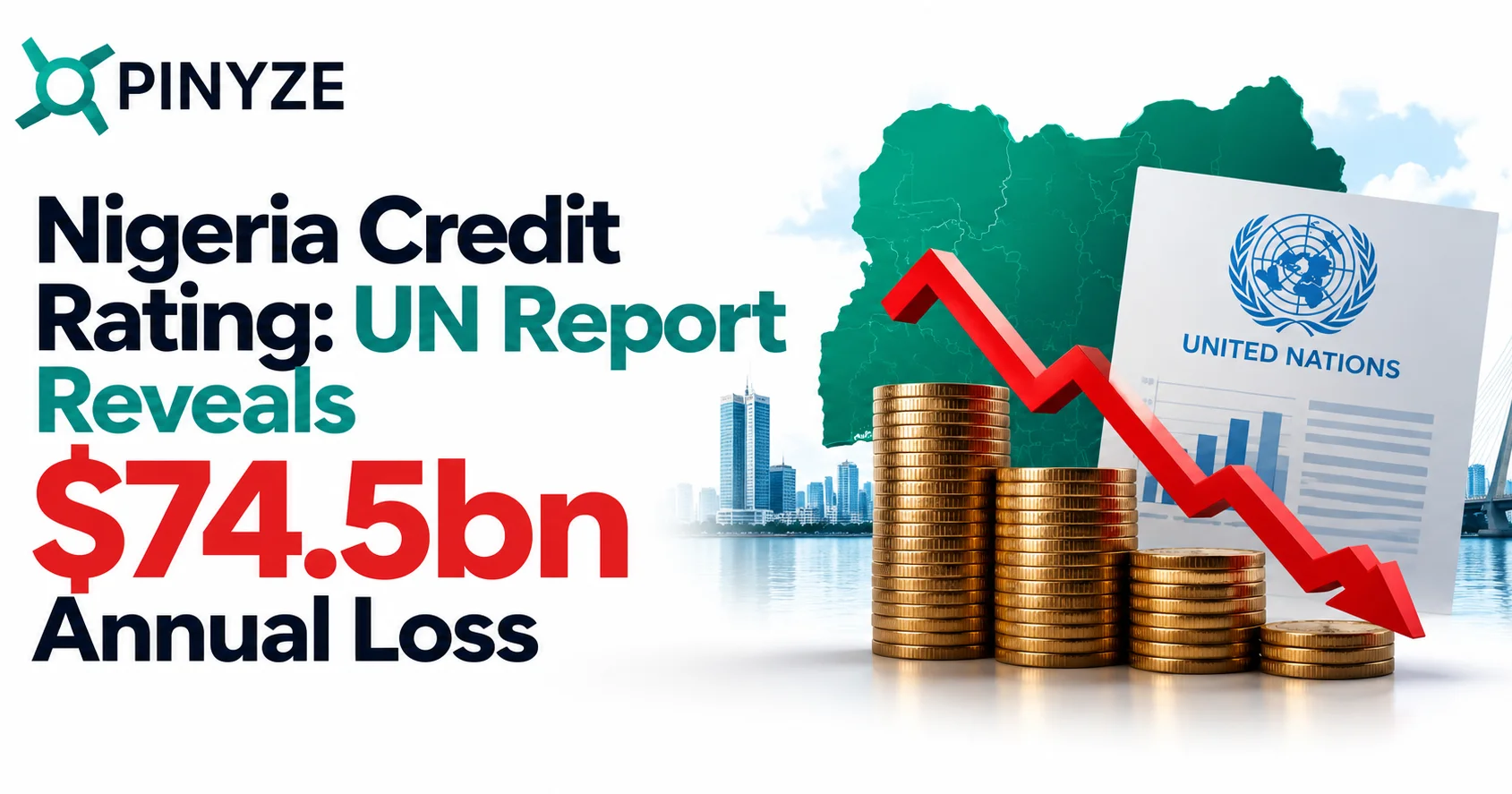
A sovereign credit rating measures a government's ability and willingness to repay borrowed money on time. On 8 October 2026, the United Nations Office of the Special Adviser on Africa revealed that context-poor risk assessments cost African nations $74.5 billion every year through high borrowing costs and lost financing. This figure highlights the core issue in the nigeria credit rating debate, where high risk premiums force African governments to pay elevated interest rates on foreign debt despite low default rates.
What is a sovereign credit rating?
A sovereign credit rating is an assessment given by specialized rating agencies to evaluate whether a national government can pay back its loans. International investors rely on these grades to decide the interest rate, or yield, they will charge when buying government bonds. Yield refers to the annual percentage return an investor earns on a debt instrument.
When a rating agency assigns a low credit score to a country, lenders classify that country as high risk. To offset that perceived risk, investors demand higher interest payments. When governments must pay higher interest rates on foreign loans, a larger portion of the national budget goes toward debt service rather than public development. Sovereign credit ratings also create a benchmark for the entire domestic economy. Lenders rarely assign a higher credit grade to local commercial banks or private businesses than the grade assigned to their national government.
Why the nigeria credit rating debate costs $74.5 billion yearly
The United Nations Office of the Special Adviser on Africa reported on 8 October 2026 that context-poor sovereign ratings penalise African economies by $74.5 billion annually. As reported by Vanguard News, this financial loss occurs through excessive interest charges and missed financing opportunities across the continent.
The United Nations pointed out that Africa's actual record of debt repayment is stronger than its commercial credit scores suggest. In its official disclosure, the United Nations stated:
"Africa’s actual default rate is far lower than what its credit ratings imply, yet the continent pays the highest cost of capital in the world"
The UN further described this extra financial burden as:
"a tax on Africa’s development, paid for no good reason"
This $74.5 billion annual loss occurs because traditional rating methodologies often fail to reflect local economic realities, such as informal commercial activity and domestic economic resilience. This information gap links directly to broader challenges, as explored in the analysis of how Africa's data gap affects long-term investment across regional markets.
How Nigeria challenged international rating agencies
Nigeria has repeatedly raised concerns at the United Nations regarding the higher risk premiums assigned to African sovereign loans. At a special meeting of the United Nations Economic and Social Council in March, Nigerian representatives presented a direct comparison between Nigeria's borrowing costs and those of an unnamed European nation with high public debt.
As reported by Nairametrics, Nigeria informed the meeting that its debt-to-gross domestic product ratio was lower than that of the European country, its foreign currency reserves were stronger, and it had never defaulted on sovereign debt payments. Gross domestic product measures the total monetary value of all finished goods and services produced within a country over a specific period.
Despite those metrics, Nigeria's dollar-denominated sovereign bonds carried yields ranging between 8.6% and 9.1%. In contrast, the unnamed European country borrowed funds at yields between 3.9% and 4.0%. Nigeria questioned why global rating agencies assign lower grades to African sovereigns while profitable commercial banks and businesses operate successfully within those same economies. Nigerian officials also pointed out that major international rating agencies maintain limited physical presence across Africa, which limits their reliance on domestic economic insights.
How high credit risk scores affect citizens and businesses
High sovereign risk ratings create broader economic consequences for individual citizens and private companies across the continent. According to Freedom Online, lower credit grades increase national borrowing costs, reduce fiscal space for development, and restrict access to foreign direct investment.
When a government must allocate more revenue toward foreign interest payments, fewer public funds remain available for essential services such as healthcare, education, and transport infrastructure. High borrowing costs also impact the private sector. Because sovereign ratings usually act as a ceiling for domestic companies, private businesses face higher interest rates when seeking international expansion or trade finance. These financing hurdles create extra costs for commercial expansion, as reflected in discussions among business leaders in the 2026 PAFTRAC survey of African CEOs. High sovereign borrowing costs can also place downward pressure on local currency stability, increasing the cost of imported goods for domestic consumers.
What to watch next as AfCRA enters the market
To address these methodology and information gaps, the African Union officially launched the Africa Credit Rating Agency on 7 October 2026 in Port Louis, Mauritius. The United Nations Economic Commission for Africa noted that the creation of AfCRA is part of wider efforts to reform Africa's financial architecture, deepen domestic capital markets, and lower interest costs.
AfCRA is designed as an independent, private-sector-driven, and self-funded institution. To protect the agency's credibility, national governments are prohibited from owning shares in the organization. AfCRA aims to complement existing international credit agencies by utilizing local expertise, informal sector data, climate resilience factors, and demographic opportunities that conventional models often overlook.
In addition, the African Development Bank is launching an initiative to assist African governments in improving credit ratings by strengthening economic transparency and data quality. Readers and market participants should watch how international bond markets respond to AfCRA's sovereign assessments, and whether expanded local data helps African nations secure lower interest yields on future debt issuances.
Written by
Opinyze Research
Editorial team
Keep reading
Related stories


Get the next report first
One email when we publish new data on what Africa thinks. No noise.
Discussion (0)
Posting will ask you to sign in. Takes about 20 seconds, your draft is safe.
No comments yet. Be the first to share your take.