Opinyze Launches Nigeria’s 2027 Presidential Ballot Poll
Opinyze has opened a poll asking who Nigerians would most prefer as president in 2027. Here is what it asks, how it works, and how to read the results.

Babatunde Alli Balogun
Co-founder, Opinyze

On this page
Opinyze has opened a poll asking who would be the most preferred candidate in the 2027 Nigerian Presidential Election. My argument is simple: a pre-election poll earns its place by recording what people think months before they vote, while there is still time to argue about it, and by stating its limits where everyone can see them.
The Case for Polling Before the 2027 Ballot
The value of a pre-election poll is timing. It records opinion while the argument is still open.
The official calendar is now tight enough that this matters. The Independent National Electoral Commission (INEC) has entered the final 100-day countdown to the 2027 General Election, with the first ballot on 16 January 2027 and the second on 6 February 2027, according to Voice of Nigeria.
INEC Chairman Prof. Joash Amupitan said the Commission had completed nine of the 14 statutory milestones in its Revised Timetable and Schedule of Activities issued on 26 February 2026. He also said 18 of the 22 registered political parties submitted 36 presidential and vice-presidential candidates.
These two facts mattered for one reason. The dates are fixed and the candidate field is largely fixed. What is not fixed is what voters want and only a poll can objectively answer that question, provided it is honest about who answered it.
What the Opinyze 2027 Ballot Poll Asks
Opinyze’s new 2027 Nigerian presidential preference poll serves three main purposes, available at the Opinyze poll page.
First, to test the feasibility of online voting in Nigeria by simulating a digital election that can also include Nigerians living abroad. Second, to measure voting preferences and identify which candidates, parties and issues are attracting the most support. Third, to understand the reasons behind voters' choices by analysing the issues, motivations and concerns shaping their decisions.
The Nigeria 2027 Pre-Election Public Opinion and Digital Voting Report will be published on the 2nd of January 2027.
The Obvious Objection.
The strongest objection to any online poll is reach. An online poll draws people who are online, and Nigeria's voter register is not an online register.
INEC put the National Register of Voters at 103 million after three phases of Continuous Voter Registration added 10,772,421 new voters. That is the population that matters on election day, and no online sample maps onto it cleanly.
The physical scale is also large. INEC says 57,000 new Bimodal Voter Accreditation System devices are in production, with a nationwide stress test scheduled for 23 to 28 October 2026 and a mock accreditation in November. INEC plans to engage 707,384 ad hoc personnel on each election day, which is 1,414,768 engagements across the two dates. It has renewed agreements to mobilise more than 100,000 vehicles and 4,000 boats.
Why Transparency Matters: The Method Behind Our Numbers
Our Polling Methodology
At Opinyze, we are combining verified respondent data, online panel sampling, quota sampling and Multilevel Regression and Post-stratification (MRP) to estimate presidential preferences across Nigeria.
1. Verified Respondent Data
Opinyze collects demographic information during user onboarding, supported by identity verification and other onboarding data.
Key variables include:
Age
Sex
State
LGA
Education
Other relevant demographic characteristics
This provides a reliable foundation for sample design and statistical modelling.
2. Quota Sampling
We use quotas to manage the composition of our sample across key demographic and geographic groups.
The quota framework considers factors such as: State, age, sex, education and other relevant characteristics. This helps ensure adequate representation of important population groups in the survey.
3. Multilevel Regression
We use a multilevel statistical model to estimate how candidate preference varies across demographic and geographic groups.
The model can account for factors such as:
Age + sex + education + geography + relevant interactions.
State-level differences are incorporated through hierarchical modelling.
4. Post-stratification
The modelled results are applied to population benchmarks from reliable demographic and electoral sources.
For each population group, the model estimates candidate preference and then weighs those estimates according to the size of that group in the target population. This produces the MRP-adjusted national and state-level estimates.
5. Validation and Uncertainty
We compare the raw results, quota-adjusted results and MRP estimates. We also test alternative model specifications and report appropriate uncertainty ranges.
6. Repeated Polling
Opinyze will conduct repeated polling waves to measure changes in public opinion over time.
As the election approaches, the methodology can also incorporate a likely-voter model based on factors such as voting intention, registration and political engagement.
Our Principle
«Collect better data. Model it carefully. Publish the method behind the number.»
This methodology is designed to provide a transparent, data-driven estimate of presidential preferences across Nigeria.
Opinyze's own rule is that poll results must never be presented as representative of all Nigerians. Results describe Opinyze users who voted, with the sample size and dates attached. That rule exists because the alternative is a headline with no dataset behind it.
Prof. Amupitan said artificial intelligence tools, voice cloning and deepfake videos have increased the risk of election-related disinformation. He urged media organisations to establish fact-checking desks, verify election-related information with INEC before publication, and avoid reporting unverified election results.
"In national elections, it is far more important to be right than to be first"
That was Amupitan, reported by Voice of Nigeria. It applies to pollsters as much as to newsrooms. A poll that hides its sample is just a headline. A poll that shows its sample is a dataset other people can check.
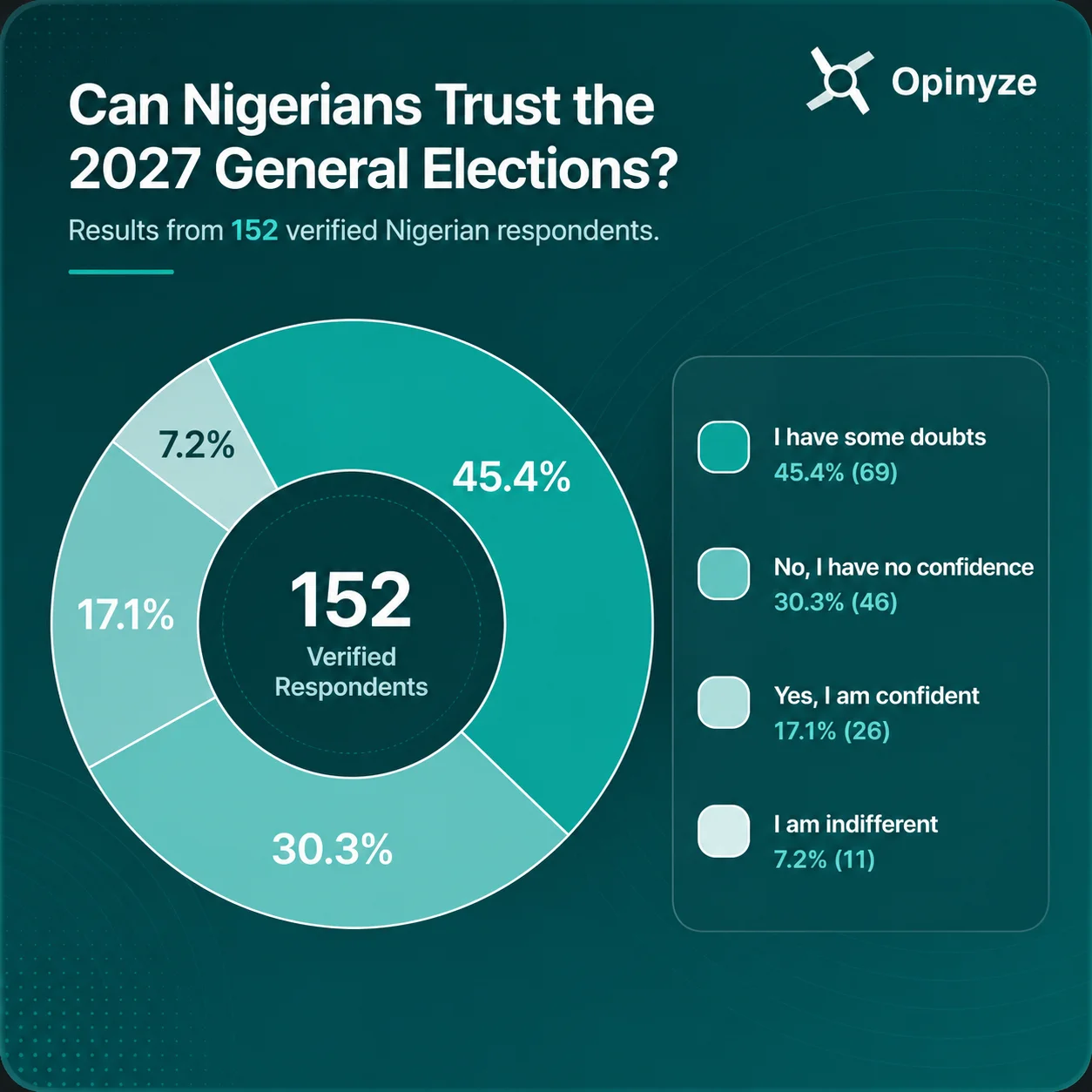
Opinyze users have already been asked related questions, including how much confidence they have in Peter Obi, in Bola Tinubu and in Atiku Abubakar. The new ballot poll sits alongside existing trend lines, so all polls connects.
How to Read Our Numbers When They Land
Check the sample size and the dates before you read the percentages. Opinyze reports both, and results are described as what Opinyze users who voted said.
Also, readers should treat the 2 January 2027 report as a snapshot of opinion at that time, not a forecast of the result. INEC's own figures show the mechanics of the vote are still being assembled in October 2026. The voter register goes on public display from 9 to 15 October 2026, and distribution of Phase One Permanent Voter Cards to local government centres starts on 9 October.
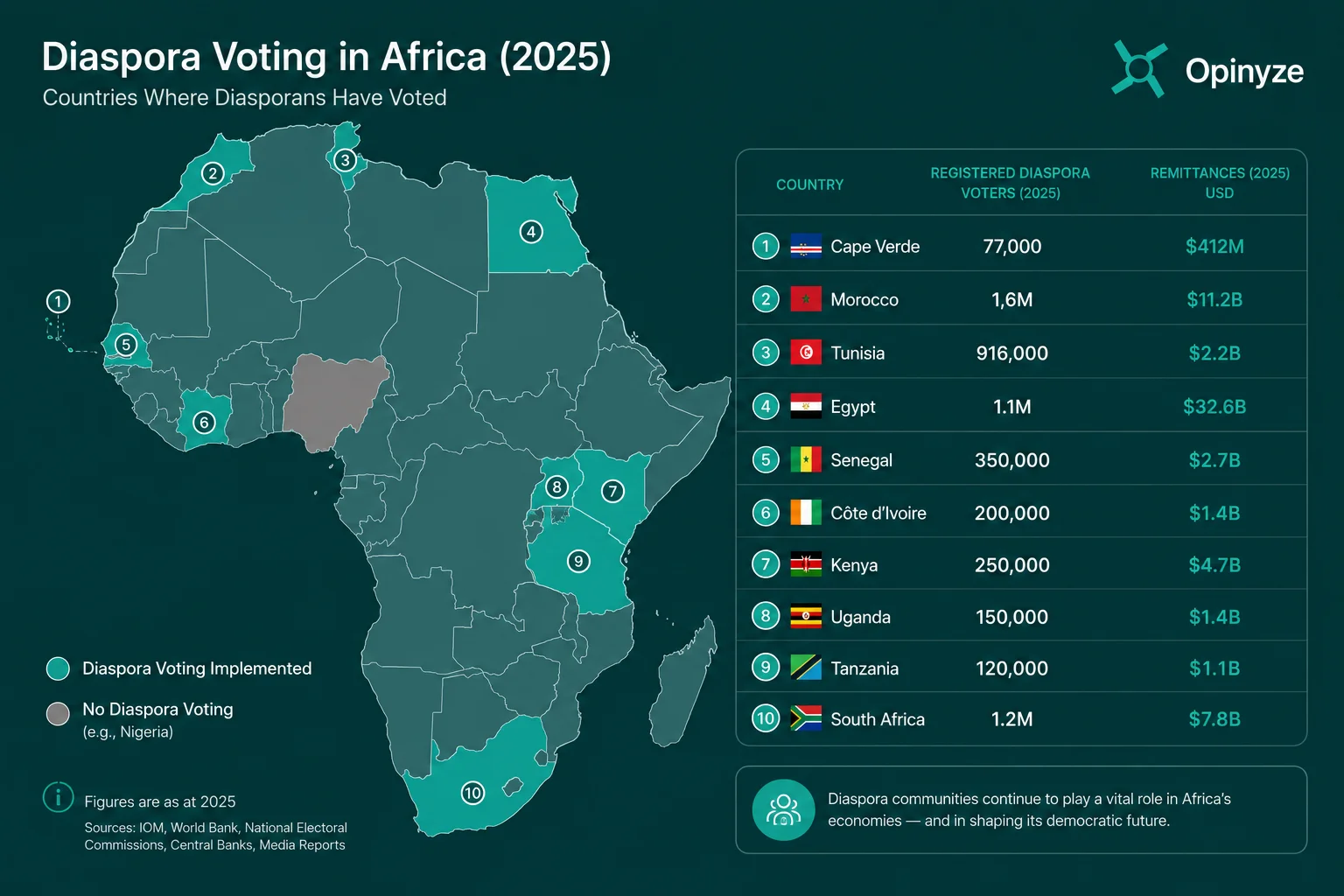
If you want to take part, the 2027 presidential ballot poll is open. If you want to follow how the official process is being judged, election integrity in the 2027 general elections is the running thread. And if the diaspora question is the one you care about, what Nigerians think about diaspora voting is the place to start.
One thing to watch: INEC says the Media Accreditation Portal will become operational before the end of October, and the final list of governorship and State Houses of Assembly candidates is scheduled for publication on 10 October. Both dates will shape what the campaign looks like by the time our report emerges.
Behind this story
Explore the data yourself
Written by
Babatunde Alli Balogun
Co-founder, Opinyze · Opinyze Research
Keep reading
Related stories

Get the next report first
One email when we publish new data on what Africa thinks. No noise.
Discussion (1)
Posting will ask you to sign in. Takes about 20 seconds, your draft is safe.
I love this